

Starting a jewelry brand does not always require designing every product from scratch or building your own manufacturing facility. White label jewelry manufacturing gives retailers, online sellers, boutiques, wholesalers, and new jewelry brands an opportunity to source professionally manufactured jewelry and sell it under their own brand identity.
Choosing the right white label jewelry manufacturer can help businesses access established jewelry designs, professional production, 925 sterling silver, gemstones, custom packaging, and wholesale manufacturing without managing every stage of production themselves.
For brands that want more product differentiation, a custom white label jewelry manufacturer can also provide options for modifying existing designs or developing jewelry according to specific requirements.
In this guide, we explain what white label jewelry manufacturing means, how it works, its benefits and limitations, how it differs from private-label and custom jewelry manufacturing, and what global buyers should check before choosing a supplier.
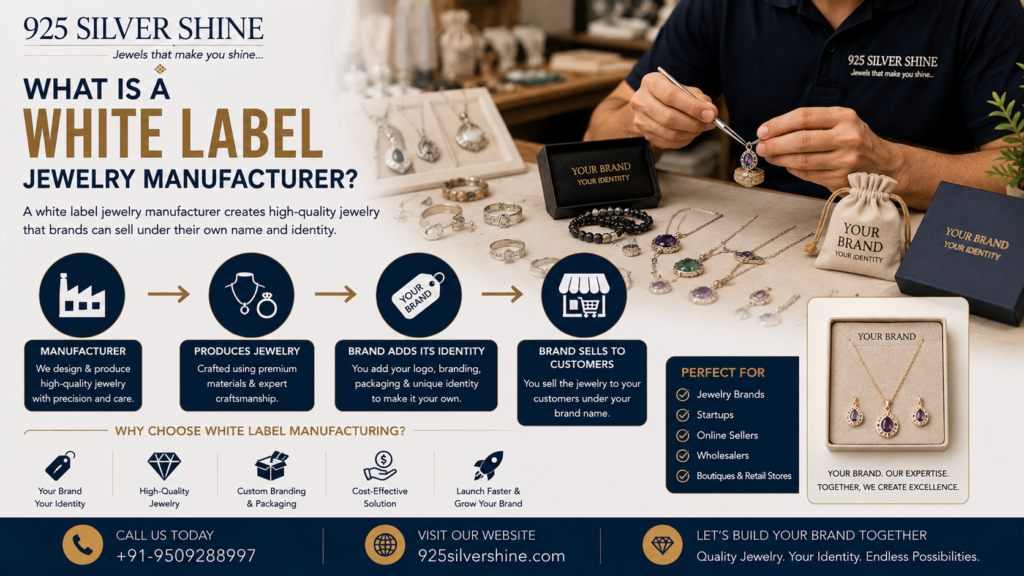
What Is a White Label Jewelry Manufacturer?
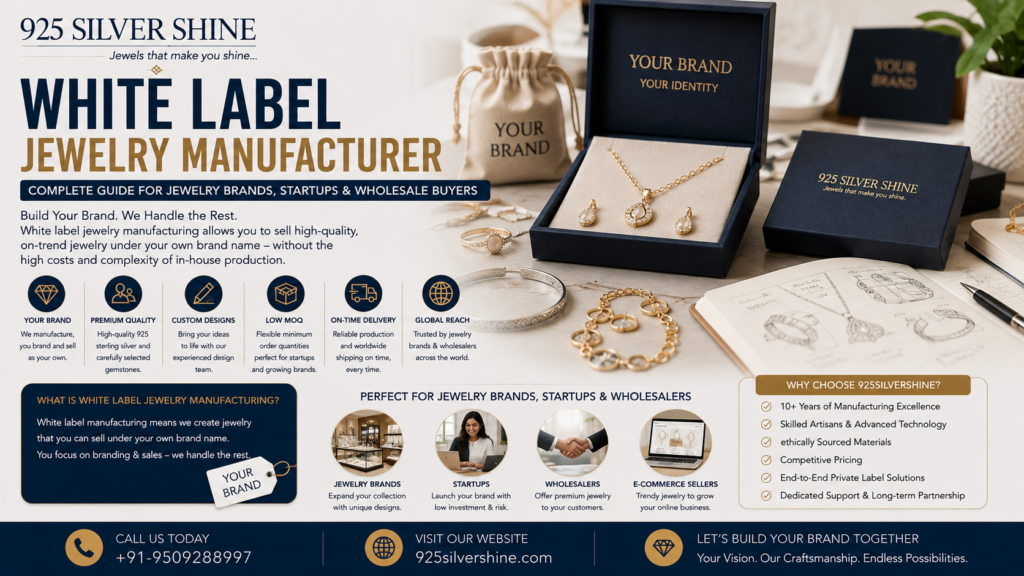
A white label jewelry manufacturer produces jewelry that can be sold by multiple businesses under their own brand names. The underlying product is generally based on the manufacturer’s existing designs or standard product range, while the retailer or brand adds its own branding, packaging, product presentation, and marketing.
In simple terms:
Manufacturer → produces jewelry → Brand adds its identity → Brand sells to customers
This model can be attractive to businesses that want to enter the jewelry market quickly without investing heavily in product development.
However, the exact meaning of “white label” is not completely standardized across the jewelry industry. Some suppliers use the term for ready-made products with branding, while others allow modifications such as gemstones, finishes, dimensions, or packaging. Therefore, buyers should always confirm what customization and exclusivity are actually included in the supplier’s service.
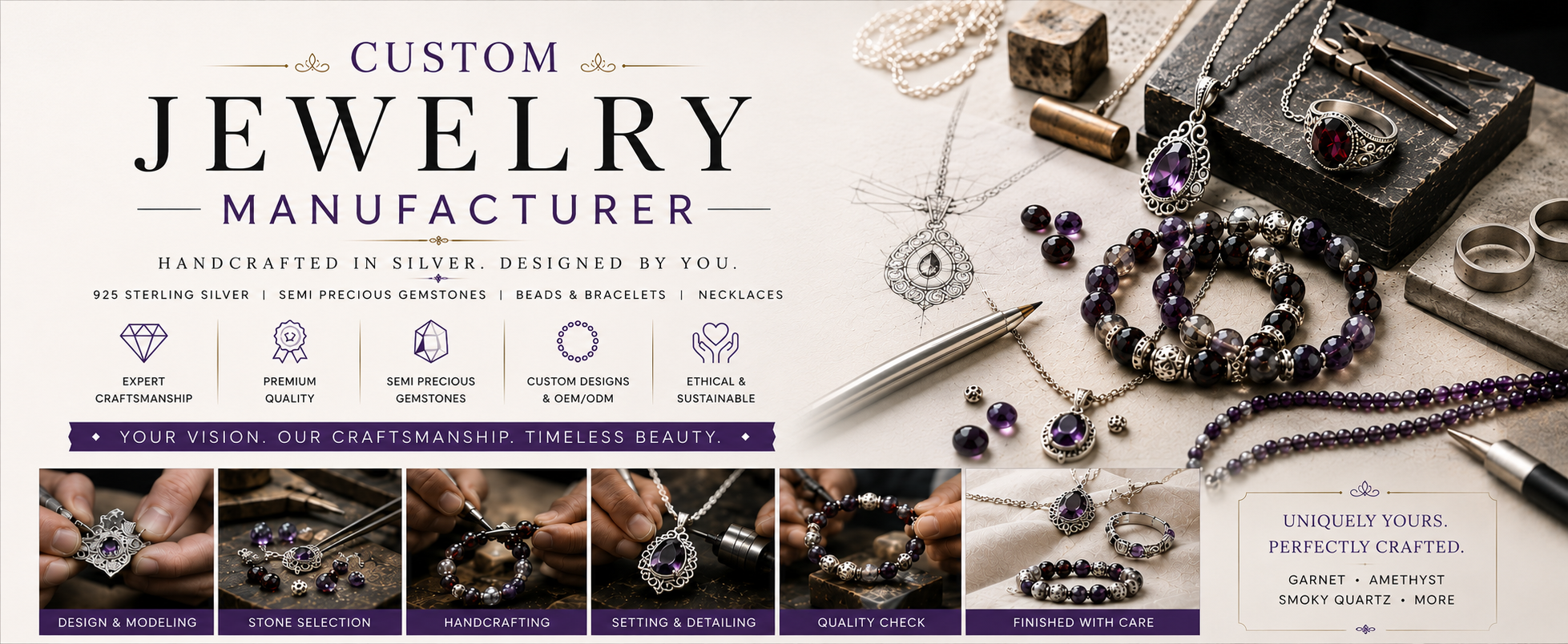
Create Your Custom
Jewelry Collection Today!
OEM Manufacturing • ODM Solutions • Private Label • Worldwide Shipping
How Does White Label Jewelry Manufacturing Work?
The process is generally simpler than fully custom jewelry manufacturing.
Step 1: Select Products
The buyer reviews the manufacturer’s existing collection and selects products that match their brand.
Possible categories include:
- Sterling silver rings
- Gemstone rings
- Silver earrings
- Gemstone earrings
- Pendants
- Necklaces
- Bracelets
- Beaded jewelry
- Spiritual jewelry
- Mala jewelry
- Custom-style jewelry
- Fashion jewelry
Step 2: Discuss Branding
The buyer discusses available branding options with the manufacturer.
Depending on the supplier, these may include:
- Logo engraving
- Jewelry cards
- Tags
- Branded boxes
- Pouches
- Product labels
- Custom packaging
Step 3: Confirm Product Specifications
Before ordering, buyers should confirm:
- Metal type
- Silver purity
- Gemstone type
- Product dimensions
- Sizes
- Finish
- Weight
- Packaging
- MOQ
- Production timeline
Step 4: Order Samples
Samples are recommended before committing to a large wholesale order. This allows the buyer to evaluate actual product quality instead of relying only on photographs.
Step 5: Place the Wholesale Order
After approving the products and branding, the buyer places the production order.
Step 6: Quality Inspection and Shipment
The manufacturer completes production, performs quality checks, packages the jewelry, and prepares the order for shipment.
Why Choose a White Label Jewelry Manufacturer?
White-label manufacturing can be particularly useful for startups and businesses that want to test the jewelry market.
1. Faster Product Launch
Because the designs already exist, businesses may not need to spend as much time on product development.
This can allow a new jewelry store to build a collection and begin selling faster than if every item had to be designed and developed from scratch.
2. Lower Product Development Requirements
Creating an entirely new jewelry collection can require design work, CAD development, prototypes, molds, samples, gemstone selection, and production testing.
White-label sourcing can reduce some of these development steps.
3. Access to Established Designs
Manufacturers often maintain collections based on their existing production capabilities.
This allows buyers to select products without starting the design process from zero.
4. Easier Collection Building
A jewelry startup can combine different categories into a complete collection.
For example:
Core collection:
Sterling silver rings + earrings + pendants
Gemstone collection:
Amethyst + moonstone + labradorite + turquoise
Spiritual collection:
Meditation + chakra + symbolic pendants
This approach can help a new store create a broader catalog.
5. Brand-Focused Selling
The manufacturer manages production while the retailer focuses on:
- Branding
- Website development
- Photography
- Marketing
- Customer service
- Social media
- Retail distribution
This division of responsibilities can make the business model easier to manage.
White Label vs Private Label Jewelry Manufacturing
One of the most important questions buyers ask is:
What is the difference between white-label and private-label jewelry?
The terms are sometimes used interchangeably, but the underlying arrangements can differ.
White Label Jewelry
White-label jewelry generally uses an existing manufacturer design that can be sold by different businesses under different brand identities.
The primary customization may involve:
- Branding
- Packaging
- Labels
- Product presentation
Private Label Jewelry
Private label jewelry generally involves products developed or specified for a particular brand, potentially with greater customization and exclusivity.
The buyer may have more control over:
- Design
- Materials
- Dimensions
- Gemstones
- Finishing
- Branding
- Packaging
- Product specifications
Industry sources also emphasize that the terminology is not standardized, so buyers should focus on the actual agreement rather than relying only on the terms “white label” or “private label.”
Simple Comparison
| Feature | White Label | Private Label |
|---|---|---|
| Existing designs | Usually | Sometimes |
| Custom design | Limited/varies | Higher |
| Branding | Yes | Yes |
| Custom packaging | Often available | Often available |
| Product exclusivity | Usually limited | Can be negotiated |
| Speed to market | Generally faster | Usually longer |
| Development cost | Usually lower | Can be higher |
| Best for | Testing and launching collections | Building differentiated collections |
The most important step is to ask the manufacturer exactly what the agreement includes.
What Is a Custom White Label Jewelry Manufacturer?
A custom white label jewelry manufacturer combines an existing jewelry manufacturing platform with some degree of customization.
Instead of ordering a product exactly as it appears in a catalog, a buyer may be able to request modifications such as:
- Different gemstones
- Different stone colors
- Different metal finishes
- Chain length changes
- Ring-size variations
- Custom engraving
- Custom charms
- Different bead combinations
- Logo elements
- Custom packaging
The amount of customization varies from manufacturer to manufacturer.
For example, a standard sterling silver pendant might be modified with a different gemstone, while the basic design remains unchanged.
This can be an attractive middle ground between standard white-label products and fully custom jewelry manufacturing.
Create Your Custom
Jewelry Collection Today!
OEM Manufacturing • ODM Solutions • Private Label • Worldwide Shipping
White Label 925 Sterling Silver Jewelry
For jewelry businesses targeting the premium or mid-market segment, 925 sterling silver is an important product category.
925 sterling silver jewelry can include:
- Rings
- Earrings
- Pendants
- Necklaces
- Bracelets
- Bangles
- Charms
- Beaded jewelry
- Gemstone jewelry
925SilverShine states that its products include 92.5% sterling silver and gemstones, with offerings covering handmade and stock-casting silver jewelry. Its FAQ also states that customers can request customization and development of designs.
For buyers, material specifications should always be confirmed with the manufacturer before placing an order.
White Label Gemstone Jewelry Manufacturing
Gemstone jewelry is particularly suitable for white-label and customized collections because one base design can potentially be offered with different gemstones.
Common gemstone categories include:
- Amethyst
- Labradorite
- Moonstone
- Rose quartz
- Garnet
- Citrine
- Turquoise
- Black onyx
- Carnelian
- Lapis lazuli
A business could take one jewelry design and create several variations based on gemstone color.
For example:
Design A: 925 sterling silver + moonstone
Design B: 925 sterling silver + amethyst
Design C: 925 sterling silver + labradorite
This can help a retailer create a wider product range while maintaining a consistent visual identity.
Natural gemstones can have variations in color, inclusions, transparency, and pattern. These characteristics should be communicated accurately in product descriptions.
Benefits of Custom White Label Jewelry
A custom white label jewelry manufacturer can provide several advantages for growing businesses.
Product Differentiation
Small modifications can make a standard design more suitable for a particular customer segment.
Brand Consistency
Custom packaging, jewelry cards, logos, and selected materials can create a consistent brand experience.
Faster Than Fully Custom Development
Starting from an existing manufacturing design may reduce some development time compared with creating a completely new product.
Easier Inventory Planning
Brands can begin with selected products and expand the collection based on sales performance.
Lower Initial Risk
Instead of developing dozens of completely new designs, a startup can test a smaller selection before investing in larger custom collections.
Who Should Work With a White Label Jewelry Manufacturer?
White-label jewelry manufacturing can suit several types of businesses.
Jewelry Startups
New entrepreneurs can use existing designs to launch a collection without building an extensive product-development process.
Online Jewelry Stores
E-commerce businesses can create branded catalogs while the manufacturing partner handles production.
Boutique Retailers
Boutiques can select jewelry that matches their store’s customer base and style.
Fashion Brands
Fashion businesses can add jewelry to their product range without establishing an internal jewelry production department.
Wholesale Buyers
Wholesalers can purchase collections in bulk and distribute them through their own retail network.
Gift and Lifestyle Businesses
Jewelry can complement lifestyle, spiritual, fashion, wellness, and gifting product lines.
How to Choose the Best White Label Jewelry Manufacturer
Choosing a supplier based only on price can create quality and delivery problems.
Instead, evaluate the manufacturer using several factors.
1. Manufacturing Capability
Check whether the manufacturer actually produces jewelry or simply acts as a reseller.
A direct manufacturing relationship can provide better communication around specifications and customization.
2. Product Quality
Request samples before placing large orders.
Check:
- Metal finishing
- Stone setting
- Product weight
- Surface quality
- Clasps
- Soldering
- Dimensions
- Overall craftsmanship
3. Material Transparency
Ask for clear information about:
- Silver purity
- Gemstone type
- Stone treatment
- Plating
- Other materials
4. MOQ
Minimum order quantity is especially important for startups.
Ask whether MOQ is calculated:
- Per design
- Per gemstone
- Per size
- Per color
- Per collection
- Per total order
5. Customization
If you are searching specifically for a custom white label jewelry manufacturer, ask what modifications are possible.
Do not assume “custom” automatically means fully custom manufacturing.
6. Branding Support
Ask whether the supplier offers:
- Logo engraving
- Branded boxes
- Jewelry cards
- Pouches
- Tags
- Labels
7. Sample Process
A professional sample process allows you to approve the product before bulk production.
8. International Shipping
Global buyers should confirm:
- Shipping methods
- Export documentation
- Packaging
- Delivery estimates
- Duties and taxes responsibilities
White Label Jewelry for Private Label Brands
Many jewelry businesses begin with white-label products and gradually develop private-label collections.
This can be a practical growth strategy.
Stage 1: Test the Market
Select existing products and sell them under your brand.
Stage 2: Identify Best Sellers
Monitor which products receive the most interest and sales.
Stage 3: Customize Successful Designs
Modify popular products with different gemstones, sizes, finishes, or branding.
Stage 4: Develop Exclusive Products
Once your business understands customer preferences, develop more customized or exclusive collections.
This progression can reduce unnecessary development costs while allowing the brand to learn from actual customer demand.
How 925SilverShine Can Support Jewelry Businesses
925SilverShine describes itself as a 925 silver jewelry manufacturer, wholesaler, and exporter with experience in gemstone silver jewelry. Its company information states that the business has roots in jewelry making dating back to 1945 and has manufactured and supplied designer silver jewelry since 1995.
Its customization service allows buyers to upload a design, customize an existing design, or work with its designers. The company explains that customers can share a photograph or sketch, select gemstone specifications, and receive a quote based on the requirements.
For businesses considering white-label or customized jewelry, this type of workflow can be useful because buyers can begin with an existing concept and determine whether modifications are required.
You can explore the manufacturer’s jewelry and customization options through 925SilverShine.
Questions to Ask a White Label Jewelry Manufacturer
Before placing your first wholesale order, ask the manufacturer:
Are the designs existing catalog products or exclusive to my brand?
This is important if exclusivity matters to your business.
Can I modify the existing designs?
Ask about gemstone, size, finish, dimensions, engraving, and packaging changes.
What is the MOQ?
Confirm minimum quantities before requesting a quotation.
Can I order samples?
Always evaluate samples when possible.
What metal and gemstones are used?
Request clear material specifications.
Can you provide branded packaging?
This is important for a professional customer experience.
Can you reproduce successful designs?
Reliable repeat production is important when a product becomes a bestseller.
What is the production lead time?
Confirm realistic timelines before advertising products to customers.
Do you ship internationally?
Global buyers should understand the shipping process and responsibilities.
Common Mistakes When Buying White Label Jewelry
Choosing Only by Price
The cheapest supplier is not always the most cost-effective option.
Poor finishing, inconsistent stones, delayed production, or unreliable communication can cost more in the long run.
Skipping Samples
Product photographs cannot always show the actual weight, finish, proportions, or craftsmanship.
Not Clarifying Exclusivity
If you expect a design to be exclusive, put the arrangement in writing.
Ignoring MOQ
Low unit pricing may not be useful if the minimum order is too large for your inventory budget.
Not Confirming Materials
Jewelry product descriptions should accurately reflect what customers are purchasing.
Ordering Too Many Designs Initially
New businesses may benefit from testing a focused collection before investing heavily in inventory.
Frequently Asked Questions
What is a white label jewelry manufacturer?
A white label jewelry manufacturer produces jewelry that businesses can sell under their own brand, generally using the manufacturer’s existing designs or standard products with branding and packaging added by the retailer.
What is a custom white label jewelry manufacturer?
A custom white label jewelry manufacturer offers existing jewelry designs with some customization, such as gemstone changes, finishes, dimensions, engraving, branding, or packaging.
Is white label jewelry the same as private label jewelry?
Not necessarily. White-label products generally start from existing designs, while private-label arrangements can involve greater customization and exclusivity. Because terminology varies between manufacturers, buyers should confirm the exact arrangement.
Can I sell white label jewelry under my own brand?
Yes. The purpose of white-label manufacturing is generally to allow businesses to market manufactured products under their own branding, subject to the manufacturer’s terms.
Can white label jewelry be made with 925 sterling silver?
Yes. 925 sterling silver is widely used for rings, earrings, necklaces, pendants, bracelets, and gemstone jewelry. Buyers should confirm the exact metal specification with their manufacturer.
Can I customize gemstones?
Some manufacturers allow buyers to change gemstones or choose from available stone options. The extent of customization depends on the manufacturer and product.
Is white label jewelry good for startups?
It can be a practical option for startups because existing products can reduce the need for extensive initial product development. Startups should still evaluate MOQ, samples, quality, margins, branding, and supplier reliability.
Final Thoughts
Choosing the right white label jewelry manufacturer can help jewelry startups, online retailers, boutiques, wholesalers, and established brands build a product catalog without developing every design from scratch.
White-label manufacturing can offer speed, product variety, easier collection development, and opportunities for branded packaging. A custom white label jewelry manufacturer can provide an additional level of flexibility by allowing businesses to modify selected products according to their brand requirements.
For businesses selling sterling silver and gemstone jewelry, the most important factors are not simply price. Buyers should evaluate manufacturing capability, material transparency, product quality, MOQ, customization options, sampling, branding support, production consistency, and international fulfillment.
925SilverShine offers 925 sterling silver and custom gemstone jewelry manufacturing, wholesale supply, and custom jewelry development from Jaipur, India. Its manufacturing and customization services can be explored by businesses looking to develop branded or customized jewelry collections for international markets.
The best manufacturing relationship is one that allows your business to balance quality, customization, brand identity, production reliability, and commercially viable pricing. For a new jewelry brand, starting with carefully selected white-label products and gradually moving toward customized collections can be a practical way to build a stronger and more differentiated jewelry business.