

Launching a successful jewelry collection requires more than attractive designs. Jewelry brands must find the right balance between product quality, manufacturing costs, reliable supply, customization, and customer expectations. For wholesalers, shopkeepers, online jewelry sellers, and startups, choosing the right manufacturing partner can make a significant difference to long-term business growth.
Working with an experienced OEM jewelry manufacturer allows businesses to turn their own product ideas and specifications into finished jewelry without establishing their own production facilities. From custom 925 sterling silver rings to gemstone pendants, bracelets, earrings, and private-label collections, a capable manufacturing partner can support product development at different stages.
At 925SilverShine, the focus is on custom jewelry manufacturing, 925 sterling silver jewelry, gemstone designs, private-label solutions, and wholesale requirements for jewelry businesses. Understanding the benefits of OEM manufacturing can help buyers decide whether this approach suits their next collection.
What Is OEM Jewelry Manufacturing?
OEM stands for Original Equipment Manufacturer. In jewelry, OEM manufacturing generally means that a buyer provides a design, drawing, CAD file, reference sample, or detailed product specifications, and the manufacturer produces jewelry according to the agreed requirements.
For example, a jewelry brand may want to launch an exclusive collection of oval gemstone rings in 925 sterling silver. The brand defines the desired design, stone dimensions, metal specifications, finish, and order quantity. The OEM manufacturer then works through the agreed development and production process.
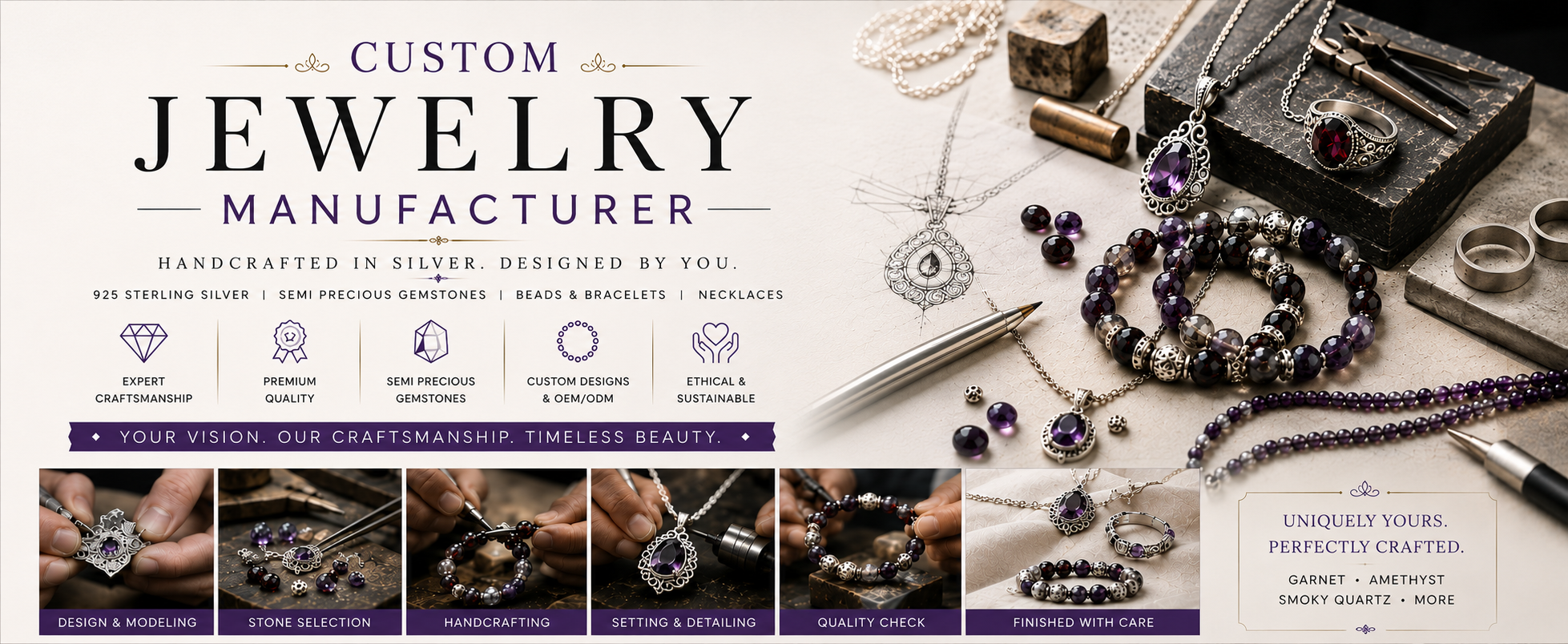
Depending on the manufacturer and project, this may include design review, prototyping, sampling, production, polishing, stone setting, quality inspection, and packaging.
OEM manufacturing is particularly useful for businesses that want greater control over product design instead of relying entirely on ready-made wholesale jewelry.
7 Key Benefits of Partnering With an Experienced OEM Jewelry Manufacturer
1. Create Jewelry Designs That Reflect Your Brand
One of the biggest advantages of OEM jewelry manufacturing is the ability to develop products around your own brand identity.
Selling the same widely available designs as many competitors can make it difficult for a jewelry business to stand out. Custom manufacturing gives you greater control over the details that make a collection distinctive.
Depending on production capabilities, you may customize:
- Metal type and product dimensions
- Gemstone selection, shape, and size
- Ring settings and bracelet styles
- Pendants, charms, and decorative details
- Surface finishes and textures
- Engraving and personalization
- Branding and packaging
For example, a boutique could develop a collection of sterling silver gemstone rings with consistent design elements that connect the products visually.
Before production, discuss design ownership, permitted reuse, and any exclusivity arrangements in writing. Custom manufacturing alone does not automatically guarantee exclusive intellectual property rights.
2. Improve Product Consistency and Quality Control
Product quality affects customer satisfaction, repeat purchases, and a brand’s reputation.
An experienced manufacturer should understand how to translate approved specifications into repeatable production requirements. This is especially important when ordering multiple units of the same ring, pendant, or bracelet.
A useful quality-control process may include checking:
- Metal specifications and product dimensions
- Surface finishing and polishing
- Stone placement and setting security
- Clasps, links, and closures
- Edges, joints, and visible defects
- Size and weight tolerances
- Final appearance against the approved sample
For a 925 sterling silver jewelry manufacturer, buyers should also clarify how silver composition is verified and which marking or documentation requirements apply to their market.
Before placing a large order, request a sample and agree on measurable acceptance criteria. An approved sample provides a reference for evaluating subsequent production, although it does not replace inspection of the finished batch.
3. Control Production Costs More Effectively
Building an in-house jewelry manufacturing operation can require investment in equipment, skilled workers, tools, materials, workspace, and production management.
Partnering with an OEM manufacturer allows businesses to use existing manufacturing capabilities instead of building every part of the production process themselves.
However, the lowest quoted unit price does not always represent the best overall value.
When comparing quotations, consider:
- Material and gemstone costs
- Design development and tooling charges
- Sampling expenses
- Minimum order quantities
- Finishing and plating requirements
- Packaging and branding
- Shipping, duties, and taxes
- Expected defect rates and rework costs
For instance, a slightly higher quotation may offer clearer specifications, better sample quality, or more suitable packaging. These factors can affect the real cost of bringing a product to market.
A professional OEM jewelry manufacturer should help clarify which requirements influence the quotation so buyers can make informed purchasing decisions.
4. Develop Custom Collections With Greater Efficiency
Bringing a jewelry idea to market involves several steps, from design development to sample approval and production.
A manufacturing partner familiar with these processes can help identify practical issues early. This may include checking whether a setting is suitable for the selected gemstone, whether a design can be produced within the intended dimensions, or whether a component needs adjustment before sampling.
A typical workflow includes:
- Share the design, sketch, or reference image.
- Confirm materials, dimensions, finishes, and quantities.
- Review the design and resolve production questions.
- Develop and evaluate a sample.
- Approve the final specifications.
- Begin production and quality inspection.
- Arrange agreed branding, packaging, and delivery.
The exact workflow depends on the design and the manufacturer’s capabilities. Sampling and approval should be included in the production schedule rather than treated as an afterthought.
5. Support Business Growth and Repeat Orders
A jewelry collection that sells well may need to be reordered, expanded, or adapted for new customers.
An experienced manufacturing partner can help a business plan for repeat production by maintaining clear product specifications, documenting approved changes, and discussing production requirements before an order is confirmed.
This can be valuable for wholesalers and retailers who need continuity across their collections.
For example, an online jewelry brand may begin with several gemstone pendants. After identifying its best-selling designs, it may expand the collection with matching earrings, rings, or bracelets.
Manufacturing requirements can change as order quantities increase, so buyers should confirm production capacity, lead times, and pricing for each new order instead of assuming that all terms will remain unchanged.
6. Make Custom Manufacturing More Accessible to Startups
New jewelry businesses often have limited budgets and little historical sales data. Investing heavily in inventory before testing demand can create unnecessary financial pressure.
Working with a custom jewelry manufacturer for small businesses can provide a route to developing a focused collection without establishing a factory.
Startups should discuss whether the manufacturer can accommodate their intended order quantities, sample requirements, and customization needs. A low-MOQ option may be available for some products, but minimum quantities depend on materials, design complexity, tooling, and production methods.
A practical approach is to begin with a manageable collection, evaluate customer feedback, and expand based on actual demand.
This allows entrepreneurs to make more informed decisions about inventory, pricing, and future product development.
7. Build a Private-Label Jewelry Business for Global Customers
OEM manufacturing can work alongside a private label jewelry manufacturer when a brand wants to sell products under its own identity.
Private-label services may include customized product specifications, branding, packaging, or collection development, depending on the agreement.
This model allows businesses to focus on marketing, customer experience, distribution, and sales while manufacturing is handled by a production partner.
It can be relevant to online jewelry stores, independent designers, boutiques, wholesale distributors, and established brands selling in the United States, the United Kingdom, Europe, Australia, and other international markets.
International buyers should clarify shipping arrangements, product descriptions, material documentation, labeling, and destination-market compliance before confirming production.
OEM vs. ODM vs. Private Label Jewelry Manufacturing
These terms are related, but they describe different aspects of sourcing and product development.
| Manufacturing model | How it generally works | Best suited for |
|---|---|---|
| OEM | The buyer supplies the design or detailed specifications | Brands with their own product concepts |
| ODM | The manufacturer provides or develops design concepts that may be adapted | Businesses seeking design support or a starting point |
| Private label | Jewelry is sold under the buyer’s brand, with the production arrangement agreed with the supplier | Startups, retailers, and established brands |
These models can overlap. For example, a business may commission OEM production and sell the finished jewelry through its own private label.
The right approach depends on how much design control, product differentiation, development support, and branding your business requires.
How to Choose the Right OEM Jewelry Manufacturer
Before committing to a manufacturing partner, evaluate more than its product photographs or advertised prices.
Review relevant experience: Ask about experience with your particular product category, such as 925 sterling silver, gemstone rings, beaded bracelets, or custom pendants.
Request samples: Examine workmanship, dimensions, finishing, stone settings, and overall product quality.
Confirm specifications: Document metal requirements, gemstone details, sizing, finishes, acceptable tolerances, and packaging.
Understand the MOQ: Confirm minimum quantities and any separate requirements for samples, custom components, or tooling.
Discuss timelines: Ask about design development, sampling, production, inspection, and shipping.
Clarify commercial terms: Confirm payment terms, revisions, defective-product handling, shipping responsibilities, and design ownership.
Evaluate communication: A dependable partner should explain requirements clearly and raise production concerns before they become expensive problems.
These checks are particularly important when working with a manufacturer in another country, where distance and time zones can make misunderstandings harder to resolve.
Why Consider 925SilverShine for OEM and Private-Label Jewelry?
925SilverShine is a Jaipur, India-based jewelry business focused on 925 sterling silver, gemstone jewelry, custom manufacturing, and wholesale supply.
For brands, retailers, wholesalers, and startups exploring a manufacturing partner, relevant product categories include sterling silver rings, gemstone jewelry, pendants, bracelets, beaded designs, and other customized collections.
The right manufacturing arrangement depends on the product, design requirements, order quantity, and desired branding. Buyers should discuss these details directly with the team, including sample development, production specifications, MOQ, quality expectations, and delivery arrangements.
Whether you already have a detailed CAD design or are beginning with a product concept, clearly defining your requirements is the first step toward evaluating a suitable OEM or private-label manufacturing project.
Frequently Asked Questions
What are the main benefits of OEM jewelry manufacturing?
OEM manufacturing can provide design control, access to established production capabilities, customized specifications, and a way to produce jewelry without building an in-house factory. Results depend on the manufacturer and the project agreement.
Is an OEM jewelry manufacturer suitable for startups?
Yes. It can suit startups that have their own designs but need production support. Startups should check sample costs, MOQ, tooling expenses, and whether the proposed order fits their budget.
What is the difference between OEM and private-label jewelry?
OEM describes a production arrangement based on the buyer’s design or specifications. Private label describes selling products under a business’s own brand. A company can use both models together.
Can OEM manufacturers produce 925 sterling silver gemstone jewelry?
Some manufacturers specialize in sterling silver and gemstone products. Buyers should verify relevant capabilities, material specifications, sample quality, and documentation before ordering.
How do I start an OEM jewelry manufacturing project?
Prepare a sketch, CAD file, reference image, or product brief. Include the desired materials, dimensions, gemstone requirements, quantity, finish, and branding needs. Then discuss sampling, pricing, production timelines, and quality requirements with the manufacturer.
Start Developing Your Custom Jewelry Collection
Choosing an experienced OEM jewelry manufacturer can help businesses turn product concepts into well-defined jewelry collections while making informed decisions about quality, cost, and production.
For online sellers, wholesalers, shopkeepers, and growing brands, the key is to find a partner whose capabilities match the products and customers you serve.
Explore custom jewelry and manufacturing options with 925SilverShine.com or contact the team at +91-9509288997 to discuss your product requirements.