

Discover How 925SilverShine Transforms Your Jewelry Ideas into Premium Custom Creations
The global jewelry industry has experienced tremendous growth as consumers increasingly seek personalized, high-quality, and exclusive jewelry. From emerging jewelry brands and online retailers to wholesalers and established fashion companies, businesses are investing in custom jewelry to differentiate themselves in a highly competitive market.
However, creating custom jewelry involves much more than simply designing a beautiful piece. Behind every ring, necklace, bracelet, or pendant is a carefully planned manufacturing process that combines creativity, engineering, precision craftsmanship, and rigorous quality control.
Understanding the custom jewelry manufacturing process step by step helps business owners and buyers make informed decisions, communicate effectively with custom jewelry manufacturer, and ensure their final products meet the highest quality standards.
At 925SilverShine, we specialize in transforming concepts into premium jewelry through a streamlined manufacturing process that combines modern technology with traditional craftsmanship. Whether you’re developing a private label collection, launching a jewelry brand, or ordering wholesale custom jewelry, our experienced team guides you through every stage—from design consultation to worldwide delivery.
In this comprehensive guide, we’ll explain each step of the custom jewelry manufacturing process, highlight best practices, and show why partnering with 925silvershine experienced jewelry manufacturer is essential for creating exceptional jewelry.
Create Your Custom
Jewelry Collection Today!
OEM Manufacturing • ODM Solutions • Private Label • Worldwide Shipping
What Is Custom Jewelry Manufacturing?
Jewelry manufacturing is the complete process of designing, developing, producing, finishing, and inspecting jewelry before it reaches customers. It involves multiple specialized stages that require technical expertise, precision equipment, and experienced artisans.
Unlike simple handcrafted jewelry, modern jewelry customization integrates digital technology with traditional craftsmanship to achieve highly accurate designs and consistent quality. Advanced tools such as CAD (Computer-Aided Design), 3D printing, precision casting, laser soldering, and professional polishing systems have transformed the way jewelry is produced today.
The manufacturing process applies to a wide range of jewelry products, including:
- Sterling Silver Rings
- Engagement Rings
- Wedding Bands
- Earrings
- Necklaces
- Pendants
- Bracelets
- Bangles
- Chains
- Charms
- Customized Name Jewelry
- Gemstone Jewelry
- Birthstone Jewelry
- Fashion Jewelry
- Luxury Jewelry Collections
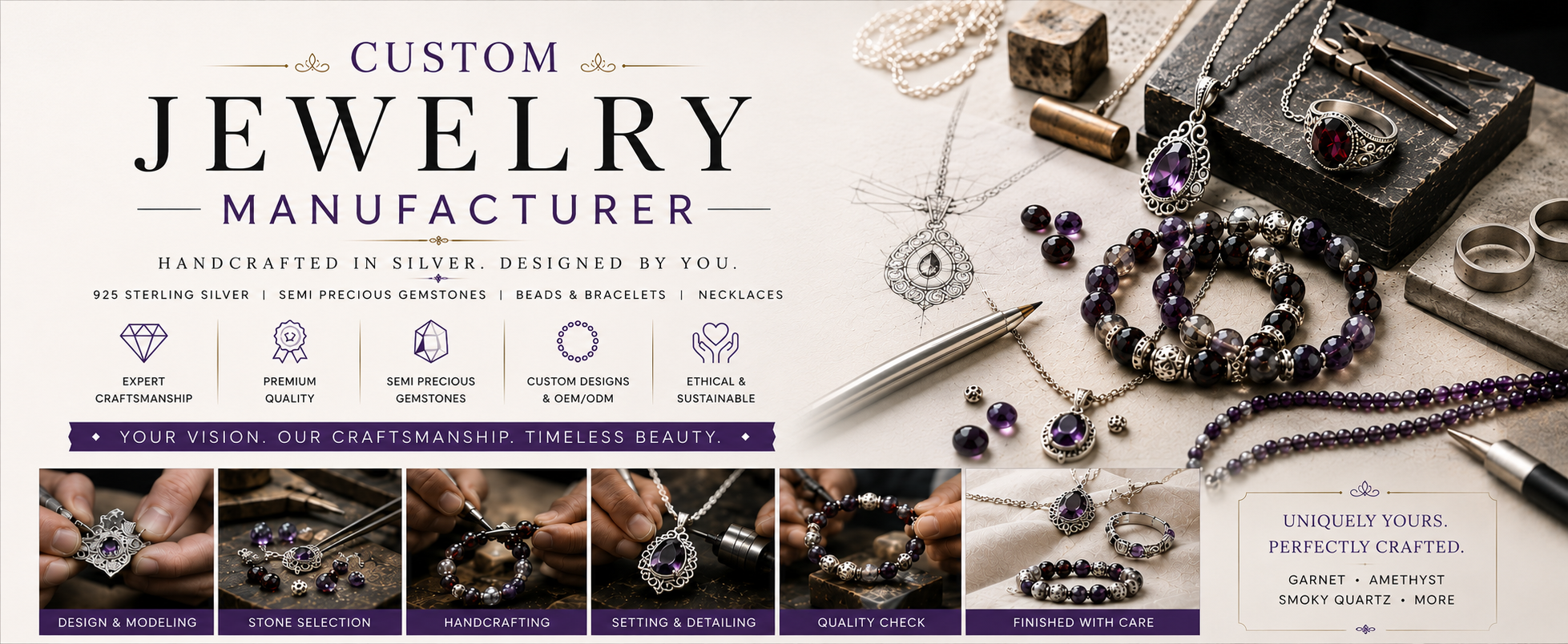
925SilverShine can also produce exclusive collections based on customer sketches, digital concepts, reference images, or completely new product ideas.
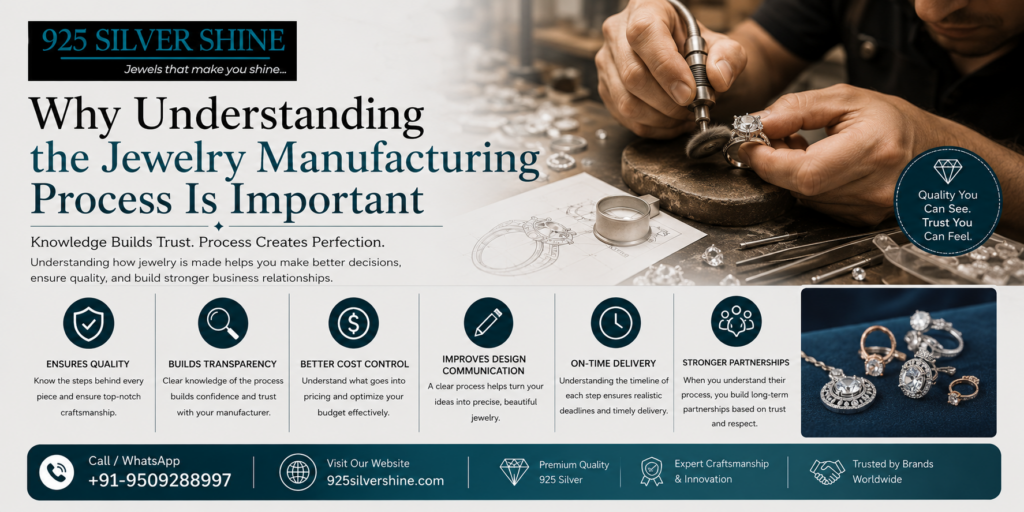
Why Understanding the Jewelry Manufacturing Process Is Important
Many jewelry buyers focus only on the finished product, but successful jewelry businesses know that understanding the custom jewelry manufacturing process leads to better purchasing decisions, improved product quality, and stronger supplier relationships.
Here are several reasons why learning the jewelry manufacturing process is valuable:
Better Product Quality
Each production stage contributes to the overall quality of the jewelry. When every step is completed correctly, the final product offers superior durability, accurate stone setting, smooth finishing, and long-lasting shine.
Improved Customization
Businesses looking for unique collections can collaborate with manufacturers throughout the design and production process. This allows greater flexibility in selecting materials, finishes, gemstones, dimensions, and branding elements.
Cost Efficiency
Understanding how jewelry is manufactured helps businesses optimize production costs without sacrificing quality. Manufacturers can recommend design improvements that reduce production complexity while maintaining the desired appearance.
Faster Production Planning
Knowing the manufacturing workflow helps brands estimate production timelines more accurately, making inventory planning and product launches more efficient.
Better Quality Control
Professional jewelry manufacturers perform inspections throughout the manufacturing process rather than only checking the final product. This minimizes production defects and ensures consistent quality across every batch.
Stronger Brand Reputation
Customers appreciate jewelry that combines beautiful design with excellent craftsmanship. Working with an experienced manufacturing partner helps businesses consistently deliver products that build customer trust and encourage repeat purchases.
For online buyers, understanding the process builds confidence when investing in custom-made jewelry.
Types of Jewelry Manufacturing Services
Different businesses have different manufacturing requirements. A professional jewelry manufacturer should offer flexible production solutions to support startups, established brands, and large-scale retailers.
Custom Jewelry Manufacturing
Custom manufacturing allows businesses or designers to create completely unique jewelry pieces based on original concepts. Clients can provide hand sketches, CAD files, photographs, or design inspirations to produce exclusive collections.
This service is ideal for:
- Independent jewelry brands
- Fashion designers
- Luxury boutiques
- Personalized jewelry businesses
- Wedding jewelry collections
OEM Jewelry Manufacturing
OEM (Original Equipment Manufacturing) enables businesses to manufacture jewelry under their own brand while leveraging the manufacturer’s production expertise. This model helps companies expand their product lines without investing in manufacturing facilities.
ODM Jewelry Manufacturing
ODM (Original Design Manufacturing) provides ready-made jewelry designs that can be customized with branding, finishes, gemstones, or minor design modifications. This is an excellent solution for businesses seeking faster product launches.
Private Label Jewelry Manufacturing
Private label manufacturing allows retailers and brands to sell professionally manufactured jewelry using their own logo, packaging, and brand identity. This approach helps businesses establish a unique market presence while benefiting from experienced manufacturing capabilities.
Also Read: Top Benefits of Custom Jewelry Manufacturing
Create Your Custom
Jewelry Collection Today!
OEM Manufacturing • ODM Solutions • Private Label • Worldwide Shipping
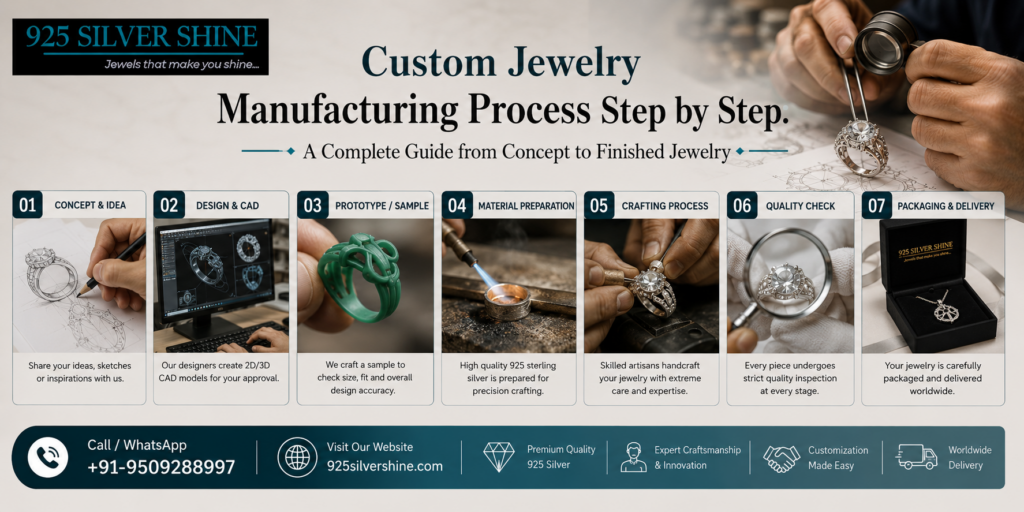
Step-by-Step Jewelry Manufacturing Process
A successful jewelry collection begins long before the final polishing stage. Every beautiful ring, pendant, bracelet, or pair of earrings starts with a creative idea that is carefully transformed into a manufacturable design. Professional jewelry manufacturers follow a structured production workflow to ensure every piece meets the highest standards of quality, durability, and aesthetics.
At 925SilverShine, the top custom jewelry manufacturer for your business, every project is handled with precision, combining modern technology with skilled craftsmanship to produce premium 925 sterling silver jewelry for global brands, wholesalers, retailers, and private-label businesses.
Let’s explore the first stages of the professional jewelry manufacturing process.
Step 1: Understanding the Client’s Vision
Every custom jewelry project begins with understanding the client’s requirements. This stage lays the foundation for the entire manufacturing process and ensures the final product aligns with the brand’s identity and target market.
Clients may provide:
- Hand-drawn sketches
- Product reference images
- CAD files
- Mood boards
- Existing jewelry samples
- Brand guidelines
- Gemstone preferences
- Metal specifications
- Product dimensions
- Logo or engraving requirements
For businesses launching new collections, 925silvershine, the best custom jewelry manufacturer for your business also provides consultation on design feasibility, production methods, material selection, and cost optimization.
A clear understanding of the project at this stage minimizes revisions later and ensures a smoother production process.
Step 2: Jewelry Design and Product Development
Once the project requirements are finalized, professional jewelry designers begin developing the initial concept.
During this stage, several factors are considered, including:
- Product aesthetics
- Wearability and comfort
- Structural strength
- Stone placement
- Metal thickness
- Manufacturing feasibility
- Budget considerations
- Weight optimization
Experienced designers balance creativity with practicality, ensuring that every design can be manufactured efficiently without compromising quality or appearance.
For businesses creating seasonal collections or signature product lines, this phase is especially important because it establishes the visual identity of the collection.
Step 3: CAD (Computer-Aided Design)
One of the most important advancements in modern jewelry manufacturing is Computer-Aided Design (CAD). Instead of relying solely on hand drawings, designers create highly detailed 3D digital models that accurately represent the finished jewelry.
CAD technology offers several advantages:
- Precise dimensions
- Accurate gemstone placement
- Symmetrical design
- Realistic 3D visualization
- Easy design modifications
- Reduced production errors
- Faster approval process
Clients can review digital renderings from different angles before production begins. This allows adjustments to be made early, saving both time and manufacturing costs.
CAD designs also help calculate approximate metal weight, stone sizes, and production requirements before any physical manufacturing starts.
For custom jewelry manufacturers, CAD has become an essential tool for delivering consistent quality and exceptional design accuracy.
Step 4: Design Approval
Before moving into production, the digital design is shared with the client for review and approval.
This step allows brands to verify every detail, including:
- Product proportions
- Dimensions
- Stone positioning
- Engraving placement
- Surface finish
- Overall appearance
If changes are needed, the CAD model can be updated quickly without wasting materials.
Only after receiving final approval does the project proceed to physical production.
This approval process helps eliminate misunderstandings and ensures the finished jewelry matches the client’s expectations.
Step 5: Creating the 3D Wax Model
After the CAD design is approved, the digital model is transformed into a physical wax prototype using advanced 3D printing or precision wax milling technology.
The wax model serves as the master pattern for the casting process.
Modern 3D wax printing offers exceptional accuracy, enabling manufacturers to reproduce intricate details that would be difficult to achieve by hand.
Benefits of wax prototyping include:
- High design precision
- Faster product development
- Better design verification
- Consistent manufacturing quality
- Reduced production waste
- Easy replication for bulk orders
At this stage, manufacturers inspect the wax model carefully to ensure it perfectly matches the approved CAD design before moving forward.
Step 6: Mold Making
For repeat production or wholesale manufacturing, molds are created using the approved wax master.
The mold allows manufacturers to produce multiple identical wax patterns with consistent dimensions and quality.
This step is particularly important for:
- Wholesale jewelry production
- Private label collections
- OEM manufacturing
- ODM manufacturing
- Large production batches
Using precision molds ensures every jewelry piece maintains the same specifications, making it easier to deliver consistent quality across hundreds or even thousands of units.
Step 7: Wax Tree Assembly
When manufacturing multiple jewelry pieces, individual wax models are attached to a central wax stem to create what is known as a wax tree.
This assembly enables several jewelry pieces to be cast simultaneously, improving production efficiency and reducing manufacturing costs.
Each wax model is positioned carefully to allow molten metal to flow evenly during casting.
Proper wax tree assembly is essential for minimizing casting defects and ensuring consistent results across all products.
Step 8: Investment Casting (Lost Wax Casting)
Investment casting, commonly known as the lost wax casting process, is one of the most widely used techniques in professional jewelry manufacturing.
The wax tree is placed inside a metal flask and surrounded with a specialized investment plaster. Once the plaster hardens, the flask is heated in a high-temperature furnace.
During heating:
- The wax melts and drains away.
- A hollow cavity is created inside the hardened mold.
- This cavity exactly matches the original jewelry design.
Next, molten 925 sterling silver is poured into the mold under carefully controlled conditions.
As the metal cools and solidifies, it takes the exact shape of the original wax model, capturing even the finest design details.
Investment casting offers several advantages:
- Exceptional precision
- Smooth surface quality
- Complex design capability
- Excellent dimensional accuracy
- Efficient large-scale production
- Minimal material waste
This process is ideal for producing rings, pendants, earrings, charms, bracelets, and other intricate jewelry pieces.
Step 9: Removing the Cast Jewelry
Once the metal has cooled completely, the investment mold is carefully broken away to reveal the newly cast jewelry pieces.
The jewelry remains attached to the metal casting tree and undergoes initial cleaning to remove any remaining investment material.
At this stage, experienced craftsmen inspect the castings for:
- Surface defects
- Air bubbles
- Incomplete filling
- Shrinkage issues
- Structural integrity
Only pieces that meet strict quality standards move to the next stage of production.
Any defective castings are identified early, reducing unnecessary processing and maintaining overall production quality.
Step 10: Initial Cleaning and Preparation
Before detailed finishing begins, the cast jewelry is separated from the casting tree.
Each piece undergoes:
- Gate removal
- Surface cleaning
- Flash trimming
- Rough filing
- Edge smoothing
This preparation stage ensures the jewelry is ready for detailed craftsmanship, including assembly, stone setting, polishing, and finishing.
Although the jewelry may still appear unfinished at this point, its core structure has been successfully created with precision and accuracy.
Why Businesses Trust 925SilverShine
1. Premium 925 Sterling Silver Manufacturing
We specialize in manufacturing high-quality 925 sterling silver jewelry that combines elegance, durability, and exceptional craftsmanship. Every piece is produced using premium raw materials and carefully inspected to meet international quality standards.
Our product range includes:
- Sterling Silver Rings
- Earrings
- Pendants
- Necklaces
- Bracelets
- Bangles
- Charms
- Gemstone Jewelry
- Birthstone Jewelry
- Minimalist Jewelry
- Fashion Jewelry
- Luxury Silver Collections
2. Complete Custom Jewelry Manufacturing
Every jewelry brand has unique custom jewelry design for every occasion requirements. Our custom manufacturing services allow clients to create jewelry from:
- Hand sketches
- CAD files
- Product references
- Design concepts
- Existing samples
- Personalized ideas
From concept development to final production, our experienced team works closely with clients to transform creative ideas into premium jewelry collections.
3. Advanced Manufacturing Technology
Modern jewelry manufacturing requires precision at every stage. 925SilverShine combines traditional craftsmanship with advanced technology, including:
- CAD Jewelry Design
- 3D Wax Printing
- Precision Lost Wax Casting
- Laser Welding
- Professional Stone Setting
- Rhodium & Gold Plating
- Laser Engraving
- Multi-Level Quality Inspection
This combination ensures every jewelry piece meets the highest standards of accuracy and consistency.
4. OEM and ODM Manufacturing Services
Whether you already have completed jewelry designs or need assistance developing new collections, we provide flexible manufacturing solutions.
OEM Manufacturing
Manufacture your own jewelry designs under your brand name while maintaining complete ownership of your product collection.
ODM Manufacturing
Choose from professionally developed jewelry designs that can be customized with your branding, preferred finishes, gemstones, and specifications. Both services help businesses reduce development time while maintaining excellent product quality.
5. Private Label Jewelry Manufacturing
Private label manufacturing allows businesses to build a strong brand identity without investing in production facilities. Our private label services include:
- Brand Logo Engraving
- Custom Packaging
- Product Labels
- Personalized Jewelry Boxes
- Care Cards
- Custom Branding
- Barcode Labels
- Retail-Ready Packaging
These solutions help businesses create a professional customer experience from production to final delivery.
6. Strict Quality Control
Quality is never left to chance. Every jewelry piece undergoes multiple inspections throughout the manufacturing process. Our quality control includes:
- Metal Purity Verification
- Stone Security Testing
- Surface Finish Inspection
- Dimension Accuracy
- Weight Consistency
- Functional Component Testing
- Final Appearance Evaluation
This systematic approach ensures every order meets customer expectations.
7. Global Export Experience
925SilverShine proudly serves jewelry businesses worldwide. Our international manufacturing capabilities support clients across:
- United States
- Canada
- United Kingdom
- Australia
- Germany
- France
- Italy
- UAE
- Singapore
- Europe
- Middle East
- Asia-Pacific
We understand export procedures, international quality requirements, and secure worldwide shipping.
Every project is handled with transparency, precision, and a commitment to quality, helping businesses create jewelry collections that reflect their unique brand identity.
Create Your Custom
Jewelry Collection Today!
OEM Manufacturing • ODM Solutions • Private Label • Worldwide Shipping
Tips for a Successful Custom Jewelry Project
To achieve the best results, keep these practical tips in mind:
- Share clear design references and specifications.
- Choose high-quality materials that match your target market.
- Review CAD files carefully before approval.
- Approve prototypes before mass production.
- Work with an experienced manufacturer that offers end-to-end services.
- Communicate openly throughout the production process.
- Prioritize quality over the lowest price.
- Build a long-term relationship with a trusted manufacturing partner.
These steps can reduce delays, improve product quality, and contribute to a smoother manufacturing experience.
Start Your Custom Jewelry Journey Today
The custom jewelry manufacturing process is a detailed journey that combines creativity, advanced technology, and expert craftsmanship. Every stage from consultation and CAD design to casting, stone setting, polishing, quality inspection, and worldwide shipping plays an essential role in creating jewelry that meets the highest standards of quality and design.
Whether you’re launching a new jewelry brand, expanding a wholesale business, or developing a private label collection, understanding each step helps you make informed decisions and build stronger partnerships with your manufacturer.
Ready to create your custom jewelry collection?
Visit 925SilverShine today. We are committed to making the custom jewelry manufacturing process simple, transparent, and reliable. With years of experience, skilled artisans, modern production facilities, and a customer-focused approach, we help businesses around the world transform ideas into exceptional jewelry collections.
If you’re looking for a trusted custom jewelry manufacturer to bring your designs to life, 925SilverShine is ready to support your journey—from your first sketch to the final beautifully crafted piece delivered to your doorstep.
Transform your jewelry vision into reality because at 925 Silver Shine, your creativity knows no bounds.